

Commercial Roofing in New Jersey: What Business Owners Need to Know Before Problems Start
Most business owners don’t think about their commercial roof—until water shows up where it doesn’t belong. A ceiling stain, a slow drip over inventory, or a leak after a storm can turn an “out-of-sight” system into an expensive disruption that affects staffing, customers, tenants, equipment, and daily operations.
In New Jersey, commercial roofs take real stress from freeze–thaw cycles, heavy rain, wind events, summer heat, and coastal moisture. That’s why choosing the right commercial roofing contractor in New Jersey matters long before an emergency hits.
3 fun New Jersey facts (that also explain why commercial roofs get punished here)
New Jersey is the most densely populated state—a small roof leak can quickly impact tenants, customers, and neighboring units in multi-tenant buildings.
NJ has about 130 miles of Atlantic coastline, and wind-driven rain is brutal on roof edges, flashing, and rooftop penetrations.
The state is known as the “Crossroads of the Revolution,” and that history means many NJ towns have older building stock—where drainage design, insulation, and prior roof layers can complicate repairs.
Quick Answer: What should a NJ business owner do before the first leak?
If you own or manage a building in NJ, the best move is a commercial roof inspection and maintenance plan—even if the roof looks fine. Commercial roof failures typically start small (a seam, a puncture, a flashing edge, a clogged drain) and become expensive only because they weren’t caught early.
A professional inspection should give you:
the roof’s estimated remaining service life
the most likely leak-risk areas (with photos)
a plan: repair now vs budget for replacement later
maintenance steps to keep warranties intact (when applicable)
Commercial Roofing Systems in New Jersey Aren’t One-Size-Fits-All
Commercial roofs operate under different rules than residential roofs. Most are low-slope or flat systems designed to handle rooftop equipment, foot traffic, and complex drainage that homes never face.
Here are the most common systems NJ business owners see:
TPO Roofing (Thermoplastic Polyolefin)
Popular for energy efficiency and heat reflectivity. Strong option for many flat roofs when installed correctly (weld quality matters).
PVC Roofing
Similar category to TPO but often chosen for chemical resistance (useful near restaurants/grease exhaust conditions). Again, workmanship at seams and details is everything.
EPDM Rubber Roofing
A long-used system that performs well on large, open roof areas. Repairs can be straightforward when leaks are caught early.
Modified Bitumen
Layered asphalt-based systems known for durability and puncture resistance—often used where traffic or mechanical abuse is expected.
Built-Up Roofing (BUR)
Multiple layers with a long track record on commercial buildings. Weight and installation complexity vary.
Bottom line: the right system depends on how the building is used (warehouse vs office vs retail), drainage design, rooftop equipment, and budget—not just square footage.
The Real Leak Triggers NJ Business Owners Should Watch For
Many commercial roof leaks are not “roof age” problems—they’re details problems.
Common leak sources:
seams (especially if workmanship or aging is involved)
punctures from foot traffic or dropped tools
flashing at HVAC curbs, vents, skylights, parapet walls
failed sealant at terminations
clogged drains/scuppers causing ponding water
saturated insulation (where water travels and hides)
Red flags inside the building:
recurring stains in the same area
musty odors (hidden moisture)
bubbling paint or warped ceiling tiles
leaks that occur only in wind-driven rain (directional storms)
Commercial Roof Repair vs Replacement in New Jersey
Most owners hope repairs solve the issue—and often they do. The key is knowing when a repair is a true fix vs a temporary delay.
Repair is usually the right call when:
the leak is isolated (puncture, small seam issue, localized flashing failure)
the roof is still within a reasonable service window
insulation is not broadly saturated
drainage problems can be corrected without major tear-off
Replacement (or restoration) becomes smarter when:
leaks keep returning in different areas
the roof is near/past its service life and repairs are stacking up
moisture is trapped in insulation across large sections
widespread membrane failure or seam breakdown is present
you’re experiencing ongoing ponding/drainage failures
Business reality: downtime costs money. Sometimes replacement is chosen not because repair is impossible, but because repeated disruptions are more expensive than the roof.
Why Commercial Roof Maintenance Saves NJ Businesses Money
Most major failures start as small issues. In NJ’s climate, regular inspections help catch:
ponding water and drainage blockages
early membrane shrinkage/separation
wind damage after storms
wear around HVAC units and penetrations
sealant failure at edges/terminations
A simple maintenance plan can:
reduce emergency calls
extend roof lifespan
support warranty compliance (when applicable)
protect interiors, inventory, and tenant spaces
A practical inspection schedule (most properties)
2x per year (spring + fall)
after major storms
before winter if you’ve had drainage or ponding issues
Choosing the Right Commercial Roofing Contractor in New Jersey
Commercial roofing demands planning, safety, and accountability. When you’re comparing contractors, look for:
Proper NJ licensing and insurance (ask to see it)
Experience with your specific system (TPO/EPDM/PVC/mod-bit/BUR)
Clear documentation (photos, scope, options, timeline)
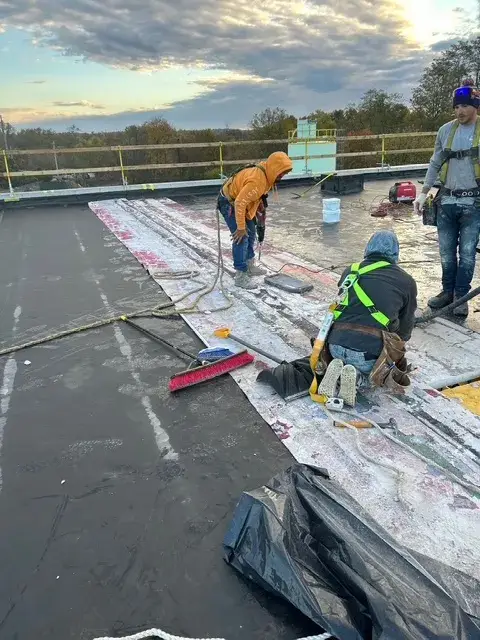
Safety-forward crews and job staging
A plan to minimize disruption (deliveries, tenants, operating hours)
A realistic warranty explanation (what’s covered and what maintenance is required)
If a contractor can’t clearly explain the leak source, the repair plan, and the risks—keep shopping.
Written by Herts Roofing & Construction
This guide is written by Herts Roofing & Construction, a licensed and insured New Jersey roofing contractor serving NJ since 2002. Our team performs commercial roof inspections, repairs, and replacements across New Jersey business properties—including retail centers, office buildings, warehouses, and multi-unit facilities.
Why we’re qualified to write about roofing (not marketing scripts):
Licensed & insured NJ contractor
Serving New Jersey property owners since 2002
Field experience with inspections, leak diagnostics, repairs, and full replacements
System-first approach (drainage, flashing, penetrations, insulation, ventilation where applicable)
Next Steps for NJ Business Owners
If your commercial roof is leaking, aging, or overdue for inspection, the smartest move is clarity—not panic.
A professional commercial roof inspection can help you:
identify the leak source and its risk level
decide repair vs replacement based on facts
reduce disruption to operations
plan budgets instead of reacting to emergencies
FAQs: Commercial Roofing in New Jersey
How do I know if my commercial roof leak is serious?
If leaks are recurring, spreading, or showing up in multiple areas, it may indicate broader membrane/seam issues or saturated insulation. Even “small” leaks can cause big damage over time.
What causes most flat roof leaks in NJ?
Common causes include seam problems, flashing failures at penetrations (HVAC/vents), punctures from foot traffic, clogged drains/scuppers causing ponding water, and termination edge failures.
How often should a commercial roof be inspected?
Most NJ properties benefit from inspections twice per year (spring/fall) and after major storms—plus extra attention if the roof has a history of ponding water.
Repair, restoration/coating, or replacement—how do I choose?
Repair: localized issues, roof still has life
Restoration/coating: depends on roof condition and system compatibility
Replacement: widespread failure, recurring leaks, saturated insulation, end-of-life roof
Will roof work disrupt my business?
A professional contractor should plan staging, safety, and scheduling to reduce disruption—especially for retail hours, deliveries, tenant buildings, and customer-facing entrances.
What should be included in a commercial roofing estimate?
A written scope, roof area assumptions, system details, drainage plan, penetration/flashing details, timeline, disruption plan, warranty terms, and documentation/photos.
Herts Roofing & Construction
20 Commerce Dr #135, Cranford, NJ 07016, United States
13 Comments