

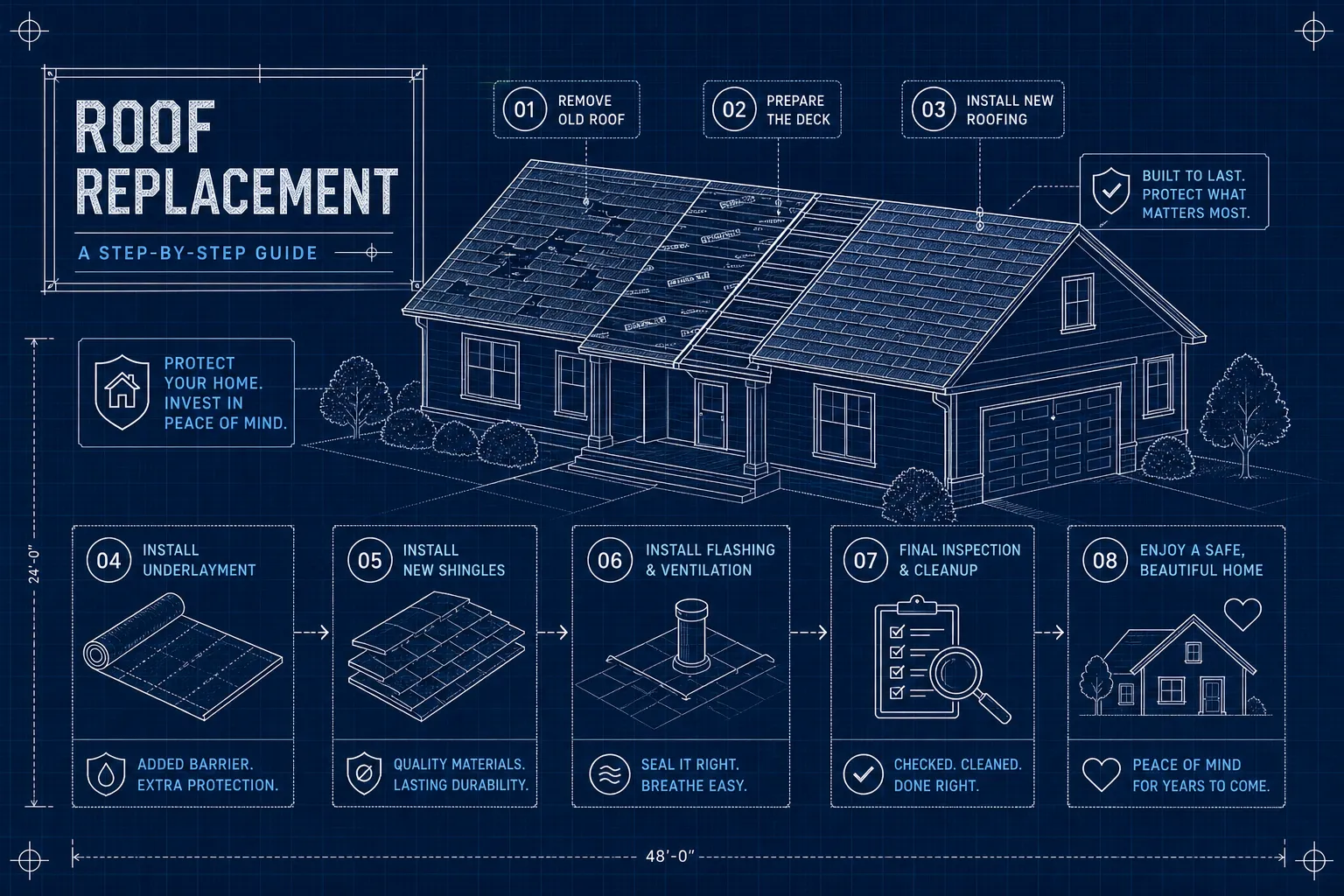
Most homeowners have no idea what actually happens on their roof during a replacement. They approve a price, hand over a check, and hope for the best. What follows is either a clean, well-documented job or a mess they don’t discover until the first hard rain fills a bucket in their living room.The roof replacement steps covered below aren’t just useful trivia. Understanding them is how you hold a contractor accountable and protect what is, for most people, a $7,000 to $15,000 investment. At Herts Roofing & Construction, we walk every Union County, NJ homeowner through the full scope of work in writing before a single nail goes in. That kind of transparency is the baseline every homeowner should expect from any contractor they hire.Below is a breakdown of eight stages in the roof replacement process: what each one involves, how long it takes, and what to watch for at every step.
1. The pre-job inspection: roof replacement steps begin before the crew arrives
The replacement process starts before the crew ever shows up. A legitimate contractor inspects the roof thoroughly, documents findings with photos, identifies code and permit requirements, and puts the full scope of work in writing. If a contractor shows up to give you a price without getting on the roof, that’s a warning sign worth taking seriously.
What a thorough pre-installation inspection covers
A complete inspection checks shingle condition, deck soundness, flashing integrity around chimneys and vents, ventilation adequacy, and the condition of fascia and soffit boards. This step determines whether you’re looking at a straightforward replacement or a project that will need additional deck repair or ventilation work built into the scope. Knowing that upfront is the difference between a smooth job and a mid-project surprise that inflates your final bill.
Scope of work, permits, and upfront pricing
In New Jersey, a full roof replacement typically requires a construction permit filed with your local municipality. Most contractors handle this filing on your behalf, which also means they take on the code-compliance responsibility. For specifics about permit requirements in New Jersey, see Do I Need a Permit for a Roof Replacement in New Jersey? A written scope of work removes the “we found more damage” conversation mid-project because it establishes exactly what was found, what will be done, and what it costs. Herts Roofing provides detailed documentation, photos, and upfront pricing with no hidden fees. That is what a professional pre-job process looks like.
2. Tear-off and re-roof steps: what removing the old roof actually involves
This is usually day one of active work. For a typical 2,000 square foot house, a full tear-off takes four to eight hours. The crew strips everything: shingles, underlayment, old flashing, and nails. Property protection matters here. Tarps down across landscaping and controlled debris management should be standard practice, not something you have to ask for.
How the tear-off process works and how long it takes
The sequence is straightforward: tarps go down, shingles come off, nails get pulled, and the deck gets swept clean. A single-layer tear-off on a simple gable roof is faster than a two-layer job, where an overlay was installed over existing shingles. Two-layer tear-offs take longer and cost more to haul away. If a contractor quotes you a price without knowing how many layers are on your roof, they’re guessing, and you’ll likely cover the difference.
Common hidden damage found under old shingles
This is where the real story often starts. Tear-offs expose all of it: rotted or delaminated decking, failed flashing around chimneys and vents, and inadequate ventilation that has been quietly trapping moisture. Damaged sheathing gets cut out and replaced with new plywood or OSB. Old flashing gets pulled and re-installed. Ventilation gaps get corrected before any new roofing material goes on. These are not optional fixes. Covering them up is how a new roof fails in ten years instead of lasting twenty-five.
3. Deck repair, drip edge, and the waterproof barrier system
After tear-off, the deck gets a full inspection in daylight conditions. Contractors walk it, probe soft spots, and replace any sheathing that has been compromised by moisture. This step is what separates a roof that performs for decades from one that develops leaks before the warranty even matters. For a broader look at repair planning and expectations, read our Comprehensive Guide to Roof Repair in NJ, Roofing Contractor in Union County NJ.
Deck inspection and sheathing replacement
Minor deck repairs are quick and relatively inexpensive. Widespread rot adds time and material costs that a solid pre-job inspection should catch in advance. If a contractor is “discovering” major deck damage as a surprise on installation day, that raises a fair question about how thorough their initial inspection actually was. A competent inspector catches most of it upfront. True surprises exist, but they should be rare, not the norm on every job.
Drip edge, flashing, ice-and-water shield, and underlayment
The waterproof barrier system is the invisible layer that actually keeps water out of your home. Drip edge goes in first at the eaves and rakes. Valley flashing, chimney flashing, and pipe boots follow.
Ice-and-water shield, a self-adhering membrane that seals around nail penetrations, gets installed at the eaves, valleys, and around all penetrations. In the Northeast, this layer is critical: it is the primary defense against ice dam infiltration during New Jersey winters. Synthetic underlayment covers the rest of the deck. None of this is visible after the shingles go on, but skimping on any of it creates leak paths that show up years later and are expensive to trace.
4. Shingle installation process: from starter course to ridge cap
This is the visible work, the part homeowners picture when they think about a new roof. Done right, it is methodical and precise. Done carelessly, it creates long-term failure points that won’t show up until well after a low-budget crew has moved on. For a detailed walkthrough of installing asphalt shingles, see this step-by-step process of installing an asphalt shingle roof.
Starter course and field shingle application
A starter strip goes down along the eave edge first. It seals the initial shingle course and prevents wind uplift at the most exposed part of the roof. Then field shingles go up course by course, staggered to eliminate vertical seams, nailed in the manufacturer-specified pattern. Proper nailing matters more than most homeowners realize: over-driven nails cut through the shingle; under-driven nails leave the fastener exposed. Either one creates a wind resistance problem that voids the manufacturer warranty and isn’t visible from the ground.
Ridge caps, hip caps, and ventilation finishing
Ridge cap shingles seal the most vulnerable part of the roof: the peak. If ridge vents are part of the ventilation design, they get installed here as well. Balanced ventilation matters: a ridge vent needs adequate soffit intake to work correctly. Without that balance, the system draws outside air in through the ridge rather than exhausting it, which defeats the purpose entirely. On Owens Corning products specifically, improper ventilation can void the shingle warranty, which is why ventilation requirements are part of the installation spec, not an afterthought. Learn more about what being an Owens Corning Preferred/Platinum contractor means at What is an Owens Corning Platinum Preferred Contractor.
5. Cleanup, final walkthrough, and what warranty protection actually covers
The job is not done when the last shingle goes on. A professional crew clears debris from the roof, empties the gutters, and runs a magnetic nail sweep across the yard before closing out. Then they walk the finished roof with you before they leave the property.
What the final inspection should include
A real final inspection covers fastener verification, flashing integration, edge work, ridge alignment, and confirmation that the finished job matches what was in the original scope. In many New Jersey municipalities, a building official inspection tied to the permit is required before the project can be formally closed. A contractor who filed for a permit should know this and handle it without you having to ask.
Understanding workmanship warranty vs. manufacturer warranty
Most homeowners treat these as interchangeable. They are not. A manufacturer warranty, like Owens Corning’s product warranty, covers defects in the shingles themselves. A workmanship warranty covers installation errors. Real coverage means a contractor who backs both with documentation, not just a handshake. Owens Corning’s Preferred Contractor program, which Herts Roofing holds, unlocks enhanced warranty tiers that include workmanship coverage backed by the manufacturer. If your installer goes out of business, a manufacturer-backed workmanship warranty still stands. A non-certified installer cannot offer that tier, no matter what they write on a contract.
6. What to ask your contractor before signing the contract
Knowing the roof replacement steps is only useful if you know what to ask. A prepared homeowner is harder to cut corners on, which is exactly why you should walk into every contractor conversation with specific questions ready.
Questions that separate professional contractors from low-quality crews
Ask these directly before you sign anything:
- Is full tear-off included, or are you proposing an overlay over existing shingles?
- Will you provide a written scope of work with line items before work begins?
- Are you licensed in New Jersey and carrying current liability insurance?
- What does your workmanship warranty cover, and for how long?
- Who handles permit filing, and is the permit fee included in the quote?
A credible contractor answers every one of these without hesitation. Deflection or vague answers are your answer. For extra guidance on vetting contractors, see our Tips for Choosing the Right Roofing Contractor in NJ.
Red flags that signal a cut-rate or unlicensed operation
Watch for these concrete warning signs: no written scope of work, vague pricing with lots of “it depends,” pressure to decide the same day they show up, no mention of permits, and crews who cannot name the shingle manufacturer or product line they are installing. The cheapest bid almost always comes with a trade-off, and it almost always shows up somewhere: materials, labor, or how fast they disappear when something leaks. A roof installed by an unlicensed or underinsured contractor is not just a workmanship risk; it creates liability exposure for the homeowner if something goes wrong during installation.
Roof replacement checklist: know the process, protect your investment
Following these roof replacement steps from start to finish puts you in control of one of the largest home improvement investments you’ll make. When you understand each stage, from the pre-job inspection through tear-off and re-roof steps, deck repair, the waterproof barrier system, the shingle installation process, and the final walkthrough, you can hold any contractor to a real standard. The homeowners who get the best outcomes are the ones who show up informed and hire contractors who welcome direct questions instead of deflecting them.
Herts Roofing & Construction offers free roof inspections across Union County, NJ and the Greater Allentown, PA area. Every project starts with a full written scope of work, upfront pricing with no hidden fees, and the workmanship backing that comes with Owens Corning Preferred Contractor status. Call to schedule a free inspection and read our Planning On Replacing Your Roof?, Roofing Contractor in Union County NJ page to prepare. You’ll know exactly what your roof needs before you commit to anything.
Frequently asked questions about roof replacement steps
How long do the roof replacement steps typically take from start to finish?
For most single-family homes, the active installation, from tear-off through final walkthrough, takes one to two days. Larger or more complex roofs, or those with significant hidden damage, can run three to four days. The pre-job inspection and permit filing add time before work begins, so plan on one to three weeks from signed contract to finished roof. For additional timelines and examples, see How Long to Replace a Roof.
What are the most important steps in a new roof installation?
Every step matters, but the waterproof barrier system, specifically ice-and-water shield, underlayment, and properly integrated flashing, does the most work. Homeowners focus on shingles because that’s what they see. The layers underneath are what actually keep water out of the house.
Do I need a permit for a roof replacement in New Jersey?
In most New Jersey municipalities, yes. A full replacement that involves structural work or a change in roofing material typically requires a construction permit. Your contractor should handle the filing and know what your specific municipality requires. If they don’t bring it up, ask directly.
What is the difference between a roof overlay and a full tear-off?
An overlay installs new shingles directly over the existing layer without removing the old material. A full tear-off strips everything down to the deck. Most building codes limit homes to two layers of shingles, and an overlay hides any existing deck damage rather than correcting it. A full tear-off is the only way to properly inspect and repair the deck before re-roofing.
How do I know if a contractor is following the correct roof replacement steps?
Ask for a written scope of work before work starts. It should detail tear-off, deck inspection, flashing replacement, barrier system materials, and shingle specifications. On installation day, you should see tarps protecting landscaping, drip edge installed before underlayment, and ice-and-water shield applied at eaves and valleys. Any contractor skipping documentation is worth questioning before you sign anything.
Herts Roofing & Construction
20 Commerce Dr #135, Cranford, NJ 07016, United States