

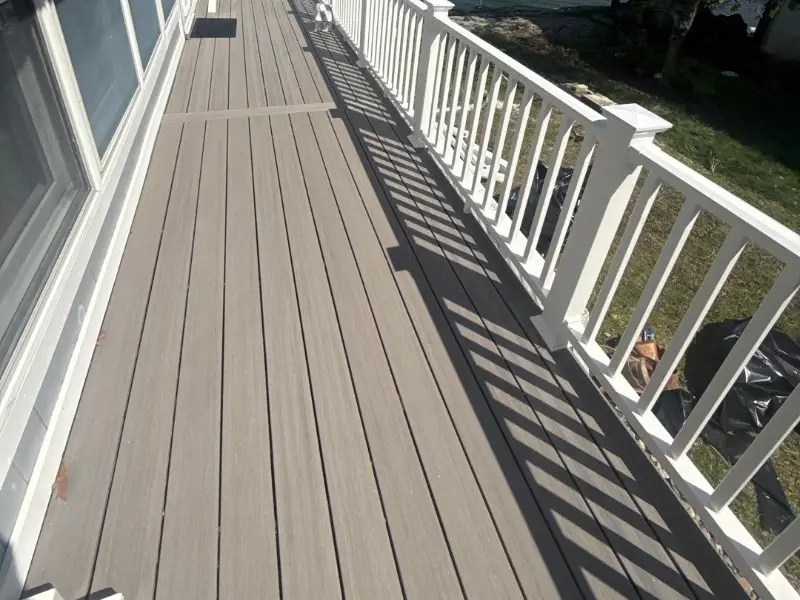
Almost every deck conversation we have with New Jersey homeowners ends up at the same question: composite like Trex, or wood? Both make great decks. They just ask very different things of you over the years, and the right choice depends on how you use the deck and how much weekend time you want to spend on it.
As a certified Trex installer that also builds wood decks, here is our honest comparison.
Side-by-side
| Trex / composite | Pressure-treated wood | |
|---|---|---|
| Upfront cost | Higher | Lower |
| Yearly upkeep | Wash it. No staining or sealing | Clean and seal or stain regularly |
| Splinters | No | Yes, as it ages |
| Rot and insects | Boards resist rot and insects | Treated, but cracks and checks over time |
| Look | Consistent color, many wood-grain styles | Real wood, weathers and grays without care |
| Heat in summer | Darker colors get warm in direct sun | Stays cooler |
Why many homeowners choose Trex
The biggest reason is maintenance. A wood deck in New Jersey goes through wet springs, hot summers, leaf piles in the fall and snow and ice in the winter. Without regular sealing, boards crack, splinter and gray. Composite boards skip all of that. A spring wash with soap and water is usually all they need.
Composite is also kinder to bare feet and kids, since it does not splinter.
Why wood still makes sense
Wood costs less to build. If you are on a tighter budget, plan to sell in a few years, or simply love the look of real wood and do not mind the upkeep, a well-built pressure-treated deck is a solid choice. It also stays cooler underfoot on a hot day.
The part nobody sees: the framing
Whatever boards you choose, the deck is only as good as the frame under it. Even Trex decks are usually framed with pressure-treated lumber. What matters most:
- Proper footings below the frost line.
- A flashed ledger board where the deck attaches to the house. Water getting behind the ledger is one of the most common reasons decks fail early.
- Correct joist spacing for the decking. Composite often needs closer spacing than wood.
- Joist tape on top of the framing to keep water out of the wood.
Can you mix them?
Yes. A common approach is composite decking with composite or aluminum railings, or a wood deck with low-maintenance railings. Stairs and railings are often where people want the least upkeep.
Frequently asked questions
How long does a Trex deck last?
Composite boards are built to last for many years and are backed by long manufacturer warranties. The framing underneath and how it was built usually decide how long the whole deck lasts.
Can I put Trex on my old deck frame?
Sometimes, if the framing is solid and spaced correctly for composite. We check the frame before recommending it.
Does Trex get hot?
Darker composite colors can get warm in direct afternoon sun. Lighter colors and shade help.
Do I need a permit to build a deck in New Jersey?
Most New Jersey towns require a permit for a new deck. Ask us about your town’s requirements during your estimate.
Planning a new deck?
Herts builds Trex and wood decks, railings and stairs across New Jersey. Call 908-206-4240 or request a free estimate and we will bring samples so you can see the colors in your own backyard.