

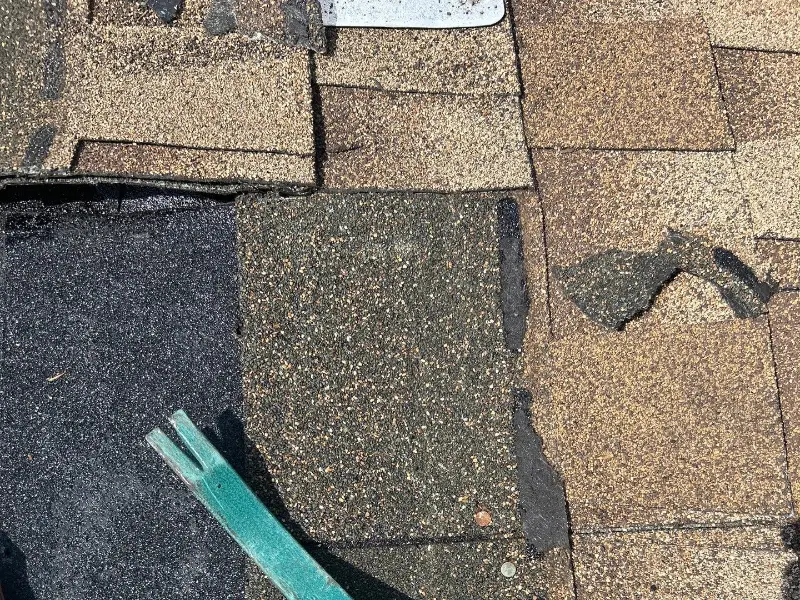
A water stain on the ceiling almost never sits right under the hole in the roof. Water gets in at one spot, runs down a rafter or along the top of the insulation, and drips somewhere else entirely. That is why so many “fixed” leaks come back. Someone patched the spot above the stain instead of finding where the water actually got in.
When we go out on a leak call in New Jersey, these are the causes we find most often, roughly in order.
1. Flashing around the chimney
Chimneys cause more leaks than anything else we see. The metal flashing where the roof meets the brick is supposed to be layered so water runs over it, not behind it. Over time the sealant dries out, the counter flashing pulls out of the mortar joints, or a previous roofer simply caulked over old metal instead of replacing it. The giveaway is a stain on the ceiling or wall near the chimney, often worse in wind-driven rain.
2. Cracked pipe boots
Every plumbing vent that comes through your roof has a rubber collar around it called a pipe boot. The rubber bakes in the summer sun and cracks after enough years, leaving a gap right around the pipe. It is one of the cheapest leaks to fix and one of the most common.
3. Missing or lifted shingles
A strong wind can lift the edge of a shingle, break the seal strip and fold it back, or tear it off completely. You may see shingles in the yard after a storm, or you may not see anything from the ground at all. See storm damage repair if this happened after high winds.
4. Valleys
A valley is where two roof slopes meet and all their water comes together. If the valley was not built with ice and water barrier underneath, or if debris builds up and holds water there, leaks show up along that line.
5. Ice dams
In a New Jersey winter, snow on the upper roof melts from attic heat, runs down, and refreezes at the cold eaves. That ridge of ice holds back water, which backs up under the shingles. Leaks from ice dams usually show up at the outside walls, near the ceiling, in January and February. Better attic insulation and ventilation reduce them; see attic insulation.
6. Clogged or overflowing gutters
When gutters overflow, water can run behind the gutter and into the fascia and the roof edge. It looks like a roof leak but the fix is at the gutter. More on that on our gutter replacement page.
7. Skylights
Skylights leak either at the flashing around the frame or through a failed seal in the glass. A foggy skylight with water between the panes is a failed unit, not a roof problem.
8. A roof that is simply worn out
If shingles are curling, cracking or bald across much of the roof and leaks keep popping up in new places, patching becomes a losing game. Our post on roof repair vs. replacement walks through how to decide.
How to narrow down a leak yourself
- Note the weather. Leaks only in wind-driven rain point to flashing or siding. Leaks after snow point to ice dams. Leaks in any rain point to a hole or a failed boot.
- Look in the attic with a flashlight during or right after rain. Follow the wet trail uphill on the rafters or decking.
- Check from the ground with binoculars for missing shingles, lifted flashing or a cracked boot. Please do not climb on a wet roof.
Frequently asked questions
Why does my roof only leak when it rains hard?
Heavy or wind-driven rain pushes water sideways under flashing and shingle edges that shed light rain fine. Chimney and wall flashing are the usual suspects.
Can a roof leak be fixed without replacing the roof?
Usually, yes. Most leaks come from one spot: a flashing, a boot or a few damaged shingles. Minor repairs typically run about $300 to $1,200 in New Jersey.
Is a small leak urgent?
Yes. A small leak soaks the decking and insulation long before it shows on the ceiling. The longer it goes, the more wood and drywall need replacing.
Have a leak you cannot track down?
Our roof repair team finds the real entry point, shows you photos, and fixes it right. Call 908-206-4240 (NJ) or 610-772-8384 (PA). If water is coming in right now, see emergency roof repair.